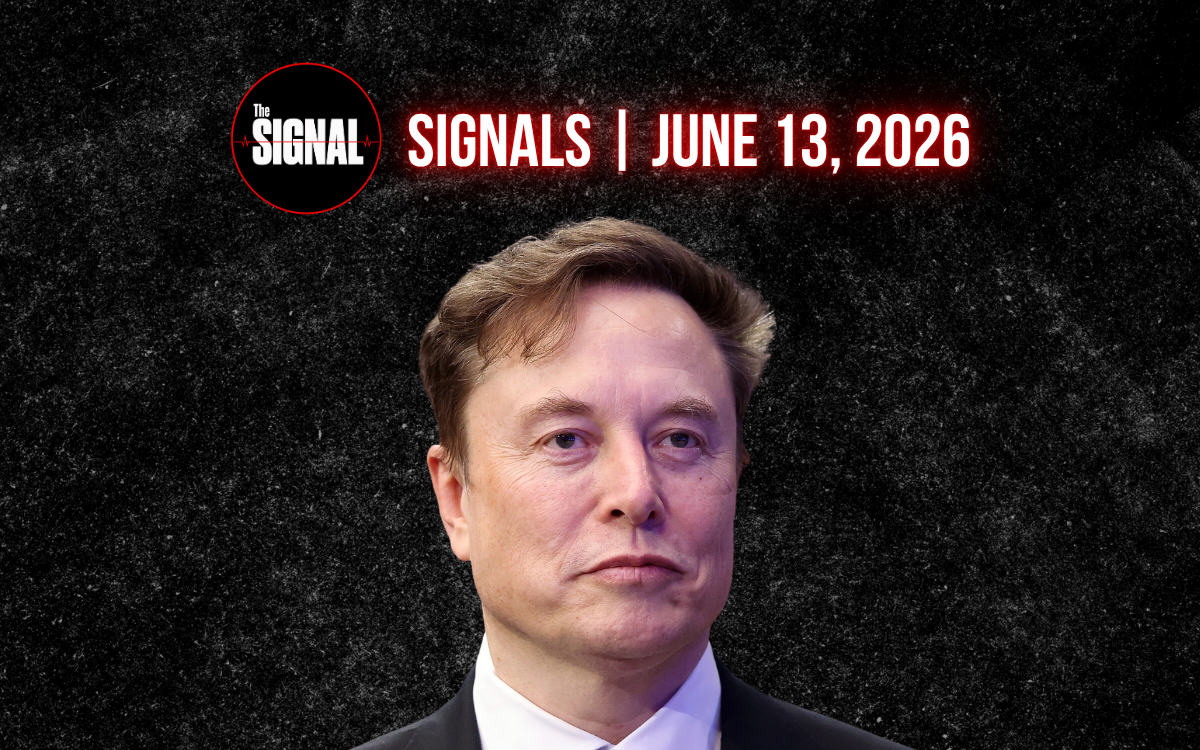
Friday morning, SpaceX opened on the Nasdaq under the ticker SPCX. By the time trading closed, the company was valued at nearly $2 trillion: the largest IPO in history. Elon Musk's stake alone is worth roughly $869 billion. Add his Tesla holdings, and his personal net worth crosses $1 trillion. The headlines call this a financial milestone. It is. But financial milestones happen all the time and nobody writes about them on Juneteenth weekend. This one is different because of what it actually represents. Almost nobody is naming it directly.
THE SIGNAL
A trillion dollars is not a bigger number. It's a different category of number.
As one financial writer put it this week, a billion dollars is the kind of money you could spend $27,000 a day for a hundred years and not run out. A trillion dollars is $27 million a day for a century. These aren't numbers that map onto anything a person can spend, use, or even meaningfully understand. At a certain point, wealth stops being currency and becomes something else: a measurement of cultural belief.
That's the real story here. SpaceX's valuation isn't primarily a bet on rockets. It's a bet on Musk himself: on Starlink, on the xAI merger, on Mars colonization, on the idea that one person sitting at the center of transportation, communication, energy, and artificial intelligence is the safest wager the market can make in 2026.
The market isn't pricing in SpaceX's current revenue. SpaceX lost $8.7 billion in the fifteen months before this IPO. The market is pricing in attention: specifically, the belief that Musk's combination of audience, narrative control, and infrastructure ownership makes him close to unstoppable.
That is a culture story wearing a finance costume.
THE EVIDENCE
Consider the timeline. As recently as 2024, Musk, Jeff Bezos, and Bernard Arnault were trading the title of "world's richest person" with net worths hovering around $200 billion each. Less than two years later, Musk's fortune is worth more than Bezos and Arnault's combined, and more than the next four richest people in the world put together.
That kind of acceleration doesn't happen through traditional business growth. It happens when markets decide someone has become a category unto themselves. When the person becomes inseparable from the platforms, narratives, and infrastructure they sit atop. X (formerly Twitter). Starlink, which now serves millions of subscribers globally and generates most of SpaceX's revenue. xAI, merged into SpaceX to compete directly with OpenAI and Anthropic. Tesla. Multiple companies, one identity, one attention economy.
Notably, this IPO is also being described by critics as a "massive wealth transfer": ordinary investors buying into a story, not a balance sheet. Whether that read is fair or not, the framing itself is telling. People on both sides of the political spectrum agree this is about belief and narrative, not fundamentals. They just disagree about whether that's good or bad.
THE INTERPRETATION
Here's what The Signal sees that the financial press is mostly missing: this is the clearest data point yet that attention has become the most liquid form of capital that exists.
Not influence in the soft sense. Actual, literal, market-priced capital. The same dynamic that determines whether a song goes viral, whether a creator's brand deal lands, whether a political figure stays relevant: that same dynamic just generated a $2 trillion valuation and minted history's first trillionaire.
This is the Attention Economy thesis, proven at the largest possible scale. Culture has always run on attention. What's new is that attention is now explicitly, nakedly the asset being priced. Not the rockets. Not the satellites. Not the balance sheet. The person.
And once markets prove that attention-as-asset works at the trillion-dollar level, every other arena where attention concentrates (music, sports, social platforms, individual creators) becomes a smaller-scale version of the same trade.
The SpaceX IPO isn't an outlier. It's a proof of concept.
THE WEAK SIGNAL TO WATCH
Here's the part almost nobody is connecting: SpaceX isn't alone in this pipeline. AI companies including Anthropic and OpenAI are reportedly laying groundwork for their own potential IPOs in the same window. The market is bracing for a year of "mega listings." Every one of them will follow the same playbook. Take an entity whose value is inseparable from a singular, attention-dominating figure or narrative, and price it not on what it earns, but on what it represents.
Watch for this pattern to repeat outside of tech entirely. Musicians, creators, and athletes who have built personal brands inseparable from platforms they control are sitting on the same kind of asset, just smaller. The infrastructure for "personal brand as tradeable asset" is being built in real time, and SpaceX just showed what the ceiling looks like.
THE PREDICTION
Within 24 months, expect the language around "personal valuation" to migrate from billionaire tech founders into culture more broadly. Creator economy platforms, music catalogs, athlete equity deals, and brand partnerships will increasingly be priced using the same logic: not "what does this person make," but "what does this person represent, and how much attention can that representation command."
The first trillionaire won't be the last. But more importantly, the logic that created him is the logic that will reshape how value gets assigned across culture for the next decade. Attention as the ultimate asset class. Musicians, athletes, and creators who understand this early and structure their ownership accordingly will be the next generation's version of this story. Just with smaller numbers and the same underlying math.
BACK TO THE NUMBER
A trillion dollars. $27 million a day for a hundred years. A number too large to mean anything as currency.
But as a signal? It means everything.
It means the market has officially confirmed what culture has known for years: attention isn't a side effect of value. It is the value. Everything else is just the vehicle. The rockets, the songs, the platforms, the followers.
The first trillionaire isn't a person. He's proof of what the entire system has been quietly pricing in all along.
SpaceX IPO valuation and Musk's net worth: SpaceX debuted on Nasdaq under ticker SPCX on June 12, 2026, with shares opening at $150 and closing up over 19% at $160.95, valuing the company near $2 trillion (the largest IPO in history). Musk's 42% equity stake was valued at approximately $869.4 billion; combined with Tesla holdings ($278.2 billion), his total stake across both companies exceeds $1 trillion. Yahoo Finance · ABC News · Al Jazeera · Washington Post
Wealth comparison context: As of mid-2026, Musk's net worth exceeds that of the world's next four richest people combined. In 2024, Musk, Bezos, and Arnault held net worths around $200 billion each. Bloomberg
SpaceX financials and business lines: SpaceX lost $8.7 billion between the start of 2025 and March 31, 2026, while investing in Starship and AI holdings via its merger with xAI. Starlink generates the majority of current revenue. PBS News
"Wealth transfer" critique and AI IPO pipeline: Commentary framing the IPO as a wealth transfer to ordinary retail investors, and reporting on AI firms including Anthropic and OpenAI laying groundwork for future IPOs in the same market window. Democracy Now · Yahoo Finance